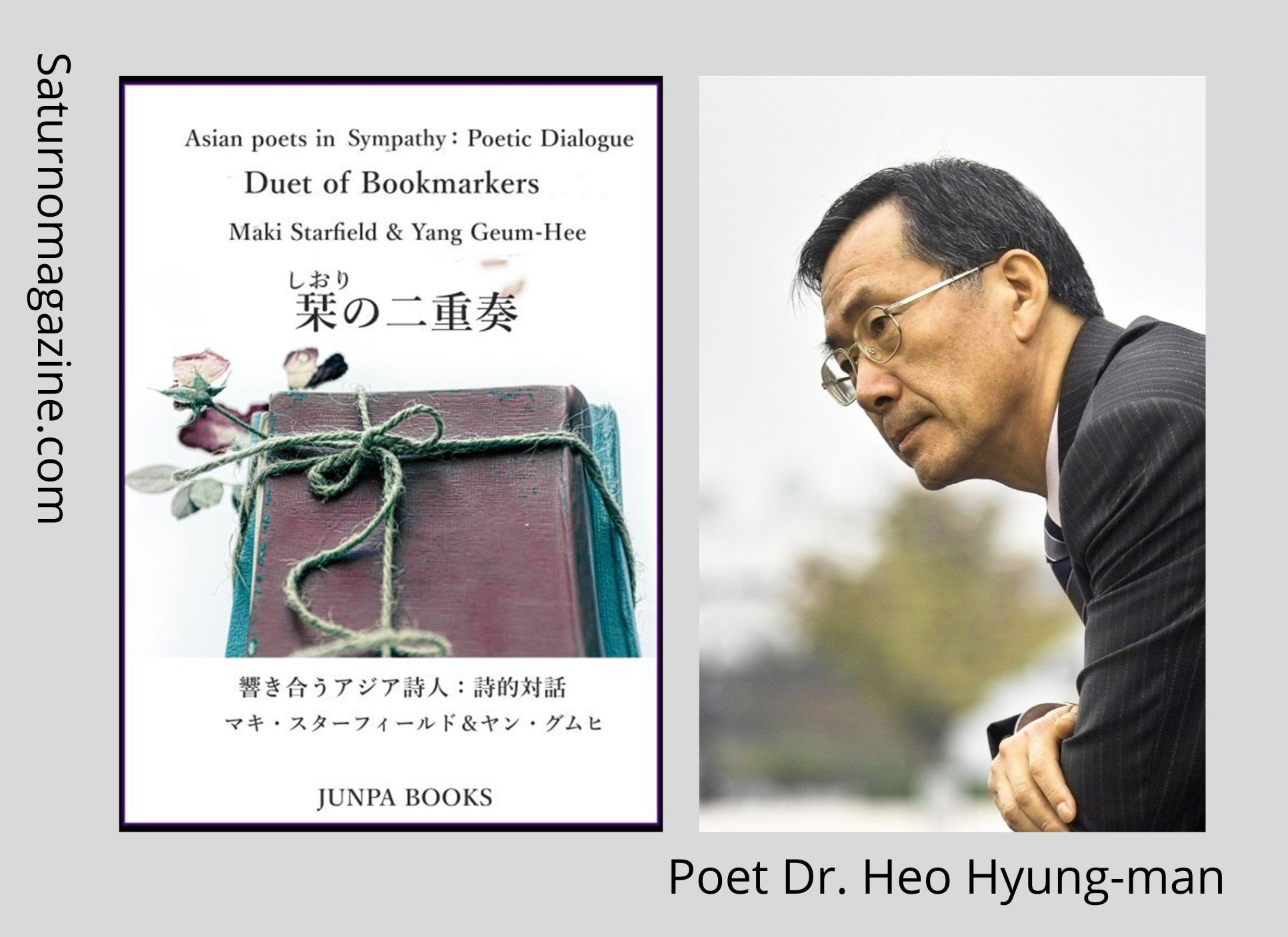
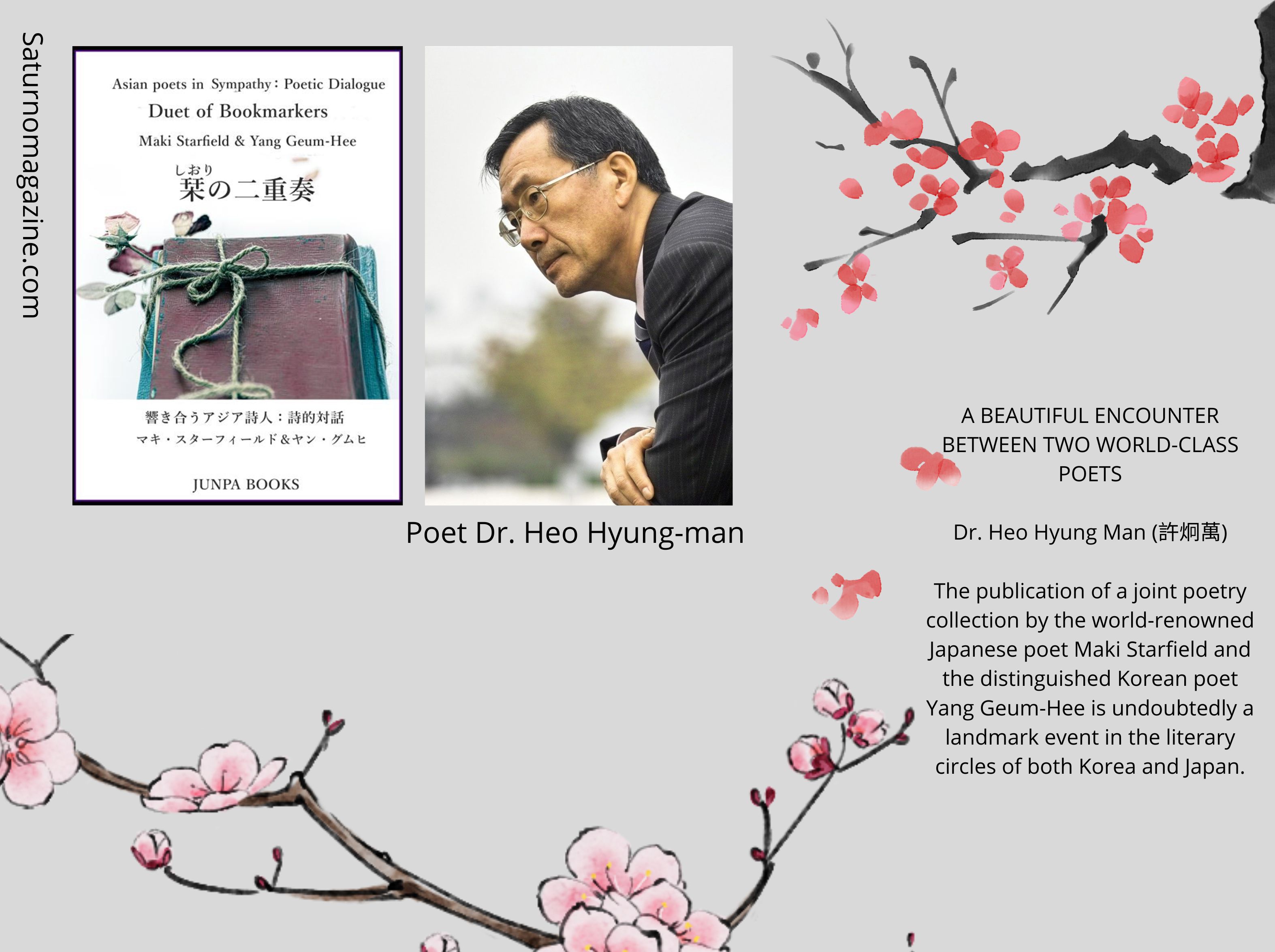
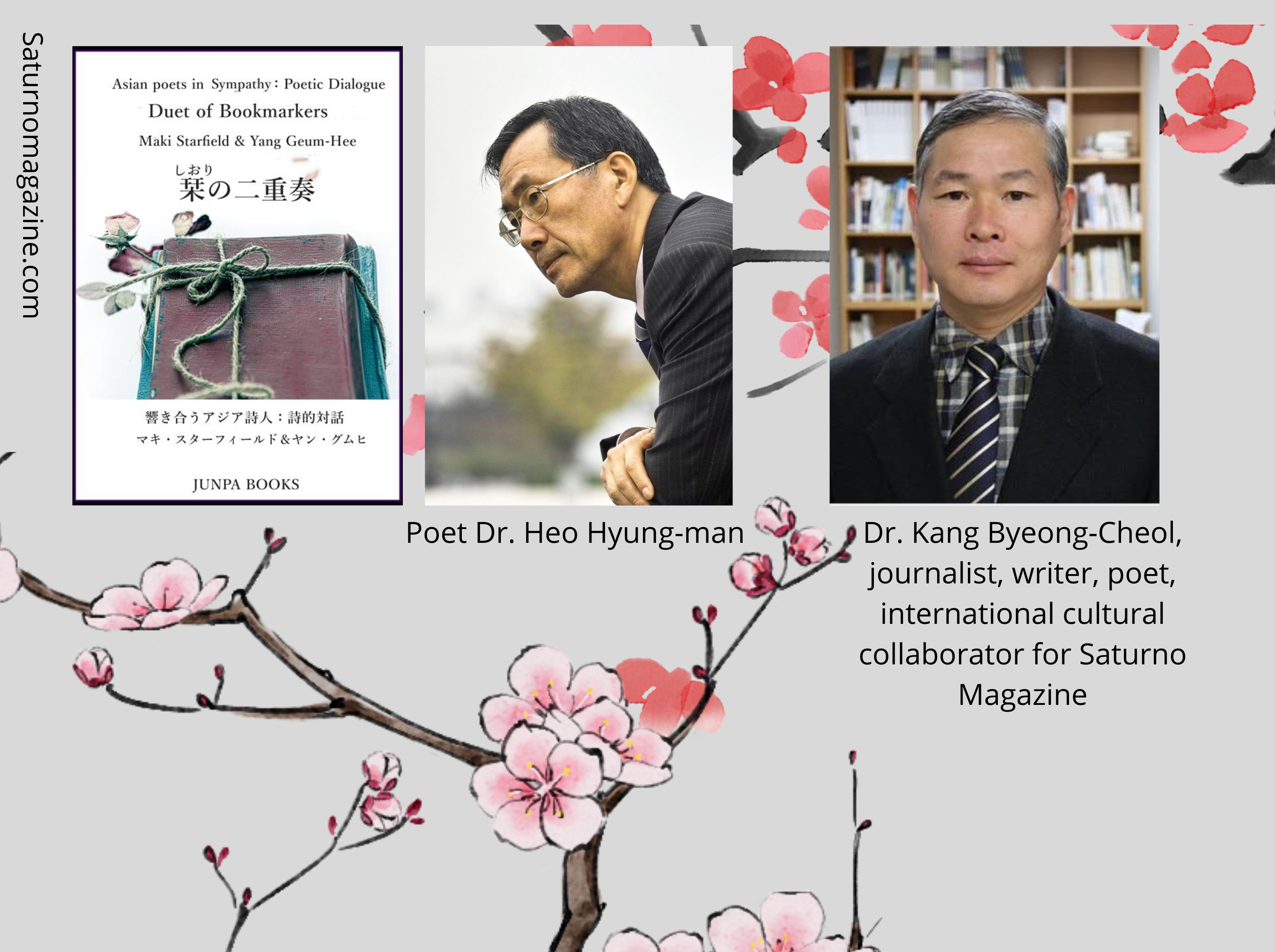

A BEAUTIFUL ENCOUNTER BETWEEN TWO WORLD-CLASS POETS - Dr. HEO HYUNG MAN (許炯萬)
A BEAUTIFUL ENCOUNTER BETWEEN TWO WORLD-CLASS POETS
Dr. Heo Hyung Man (許炯萬)
The publication of a joint poetry collection by the world-renowned Japanese poet Maki Starfield and the distinguished Korean poet Yang Geum-Hee is undoubtedly a landmark event in the literary circles of both Korea and Japan.
Maki Starfield, a highly acclaimed poet who is also well known in Korea, is a member of the International Poets Association of Japan and an active member of the literary coterie Sōkyū (蒼穹). She is also an accomplished translator, literary activist, and painter who continues to engage vigorously in a wide range of creative and cultural activities. Meanwhile, Yang Geum-Hee is one of Korea’s leading poets. She served as the second president of the Korean Association of World Literature and, based in Jeju Island, has played a central role in broadening the horizons of Korean literature and peace culture.
The value of this collection will shine all the more brightly because both Maki Starfield and Yang Geum-Hee have established firm and distinguished positions on the international literary stage.
Maki Starfield’s poetry demonstrates a remarkable ability to unite the exotic landscapes of Thailand with cosmic imagery. On the Chao Phraya River—whose name means “Great River”—she writes:
“Like something that takes the place of God,
you touch the madness of the heart,
entering the body
where I am held captive.”
The profound imagery resonates with the vastness of the cosmos. Likewise, on the beautiful island of Samet, Thailand, renowned for its crystal-clear waters and fine white sands, she writes:
“Samet Island gathers colors
as though gathering its own soul—
a jewel shaped by wind and water.
Here, the sense of eternity
slowly, softly, permeates the air.”
The breadth of her sensuous contemplation seems to sway within the universe itself.
Her interest in Thai as a foreign language, expressed in “Whispers of Words (Resonance with the Squall),” as well as her poetic evocation of Thailand in “Here, Too (Dedicated to Sunthorn Phu)”—
“A Thai twilight,
memories of sweet joy,”
—and in “Morning Psalms of Bangkok”—
“A quiet, warm wind brushes the skin.
Dawn’s light settles gently on the leaves.
Bangkok
slowly
begins to awaken.”
—reveals a poet whose insight into existence is clear and warm.
The same quality can be found in “A Prayer Without a Name”:
“At dawn, during almsgiving.
(…)
On my outstretched palms,
the whiteness of rice trembled—
its warmth brushing the inside of my chest
like the last ember
of someone’s distant prayer.”
Through her poetry, Maki Starfield demonstrates what Jean-Paul Sartre described in Aesthetics: that poetry is an art that pursues the beauty of language.
Yang Geum-Hee’s poetry, meanwhile, reveals a profound ability to perceive the essence of life through contemplation. In “The Light That Illuminates the World,” she writes:
“It glows where freedom knows no end,
where right and wrong may twist and bend.
Though its source remains unknown,
within the truth its glow has grown.
And through the ages, bold and free,
it shines for all eternity.”
These lines embody a spiritual faith reminiscent of the biblical affirmation, “The truth will set you free.”
Likewise, in “The Power Within Me,” she sings:
“Though winds may try to tear apart
the dreams once planted in my heart,
a rainbow forms, a bridge so wide,
where hope and wings grow strong inside.
And so, my dreams rise tall and bright,
bathed in youth’s enduring light.”
Her voice contains an inner force overflowing with dreams and hope. In particular, the final line—
“Move ahead—there’s nothing to fear!”
—creates a profound resonance that seems to extend even toward a prophetic spirit of faith.
Especially in “The Wind and Water Do Not Fight,” Yang Geum-Hee reflects, through the experience of her own life, upon the essence of existence and humanity. Although deeply infused with Eastern thought, the poem offers an experience of renewed vitality that speaks powerfully to our own age. In this respect, it calls to mind the words of Léon-Paul Fargue. He once wrote,
“Une phrase parfaite est au point culminant de la plus grande expérience vitale.”
“A perfect sentence stands at the culmination of the greatest vital experience.”
As we have seen, the poetic consciousness and worlds of Maki Starfield of Japan and Yang Geum-Hee of Korea are expressed through their individual poetic experiences—in other words, through their creative experiences. Yet there is one profound quality they share: both poets embody a poetic spirit that yearns for world peace and love for humanity.
When we think of the whirlwinds of war that are still tragically unfolding on our planet at this very moment, Maki Starfield’s “Here Is a Country Without War” expresses an urgent longing for a world in which:
“Here is a country without war.
There are no rivals anymore,
nor is there a domineering ruler.
Everything is peaceful,
and the people all communicate through telepathy.”
Yang Geum-Hee, too, expresses her longing for peace in “The Path to Peace”:
“As light shines brighter in the darkest night,
may peace break through with gentle might,
seeping through Gaza’s cracks of despair,
a beacon of hope in the heavy air.”
And in “A Prayer for Peace,” she offers an earnest prayer:
“Let war’s desire drift away,
flow into waters that calm the fray,
and may the warmth of peace extend,
to touch all lands and gently mend.
We pray for sunlight’s healing grace,
to spread the fragrance of peace throughout the universe,
and bind us close, all hatred undone,
together, breathing as one.”
I firmly believe that this poetry collection, created by Maki Starfield and Yang Geum-Hee in a shared poetic spirit, will become a beautiful gift to the literary worlds of both Korea and Japan.
I sincerely congratulate both poets on the publication of this remarkable joint collection.
Poet Dr. Heo Hyung-man was born in 1945 in Suncheon, Jeollanam-do, South Korea. He made his literary debut in 1973 through the literary magazine Wolgan Munhak (Monthly Literature). He has published 20 poetry collections, including Eyes of the Soul, Ecstasy, Wind Sword, and Encounter. His works have also been published abroad, including the Chinese poetry collection 許炯万詩賞析 and the Japanese poetry collection 耳な葬る.
He has received numerous literary honors, such as the Korean Poets Association Award, the Yeongrang Poetry Literature Award, the Pyeonun Literature Award, and the Gongcho Literature Award.
He served as the 9th President of the Korean Association of World Literature and is currently an Emeritus Professor at Mokpo National University.